Basket Battle
- 4.5
- Rating
- 50.00M
- Installs
- Free
- Price

 Analysis by App-foxy
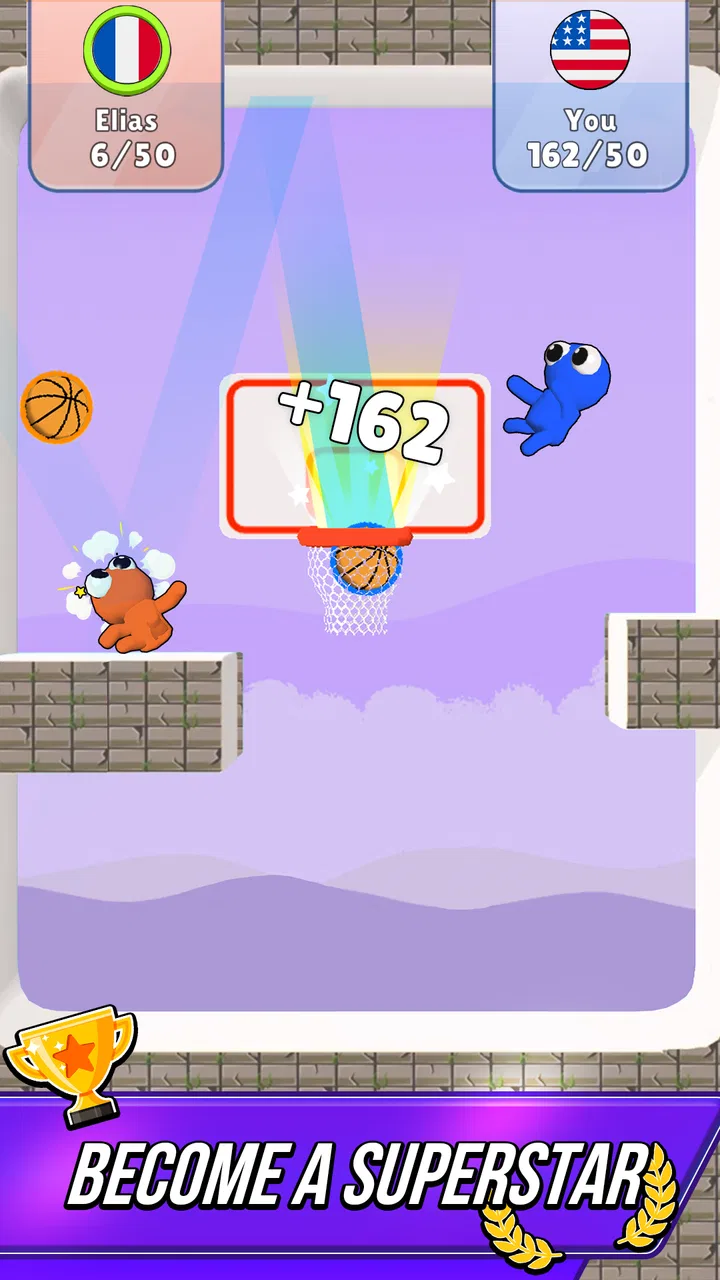
Basket Battle is the kind of sports game I open when I want a quick contest rather than a full basketball simulation. It puts the focus on a direct duel: take your shot, react to the rival, and try to finish with more points. That simple idea makes it easy to understand within moments, but the real question is whether the short matches stay interesting after the first few sessions. In my experience, the answer depends heavily on what you want from a basketball game. If you enjoy compact challenges and quick retries, it has a clear appeal. If you are looking for team management, realistic tactics, or a deep career mode, this is not aimed at you.
Developed by Supersonic Studios LTD, this free sports game has reached over 50 million installs and holds a 4.6 average from around 511 thousand ratings. Those figures suggest that its straightforward format works for a very broad mobile audience. It is rated Teen, runs on Android 7.0 or later, and the current version is 3.8.1. I would still approach it as a casual competitive game rather than a complete basketball package: its strength is the immediate one-on-one contest, not the amount of basketball content surrounding it.
What makes the first sessions work
The opening appeal is easy to understand. You are not asked to learn a large control scheme or study a long tutorial before reaching the court. The central loop is about shooting, scoring, and responding to the other side. That creates an early goal that feels natural: improve your next attempt and win the duel in front of you. I like this because the game gives me a reason to replay a match without requiring a large time commitment.
You May Also Like

 Google Keep - Notes and lists
Google Keep’s Quiet Growth Shows the Appeal of Simpler Notes
As mobile work gets busier, Google Keep keeps winning a simple contest: capture a thought quickly, find it later, and get on with the day.

 Blood Strike: 2.5 Anniversary
Blood Strike’s Loadouts Turn Every Drop Into a Tactical Gamble
A close look at Blood Strike’s custom loadouts: how fast access to signature weapons reshapes its battle royale rhythm, rewards preparation, and narrows the gap between fights.

 Pandora - Music & Podcasts
Pandora’s Music Is Easy to Start, but Harder to Recover
Pandora’s strength is its low-effort path from a seed to a station. Its weak spot is how much confidence it asks you to place in connection, setup, and quiet recovery.

 8 Ball Pool
 Is Built on Rivalries, Rematches, and Routine
A close look at the rivalries, rematches, shared routines, and unanswered safety questions that turn a quick pool match into a persistent mobile community.

 Samsung Music
’s Quiet Strength Is Playing What You Already Own
Its reach comes less from spectacle than from dependable access to a personal library. That simplicity is both the app’s strongest retention engine and its ceiling.

 AccuWeather: Weather Radar
AccuWeather Review: A Quick, Clear Forecast for Everyday Decisions
For everyday plans, the best forecast is the one you can understand quickly. AccuWeather makes rain timing, radar, and local conditions easy to act on, with a few trade-offs.
More From Our News Desk



That short-session design is especially useful in ordinary situations. I can imagine playing a few rounds while waiting for a friend, taking a break between tasks, or filling a short commute when I do not want to begin a story-heavy game. A match can feel like a self-contained test rather than a commitment. The trade-off is that the same compact structure can become repetitive if you expect every round to introduce a new strategic layer.
The early goals are therefore practical rather than elaborate. You learn how the shooting exchange feels, discover how much room you have to react, and start noticing which attempts are reliable for you. I recommend resisting the urge to play on autopilot. The most useful first-session habit is to treat every miss as information: was the shot rushed, was the timing poor, or did you misread the rival’s opportunity? That small change turns a basic arcade contest into a more deliberate skill exercise.
The best early objective is consistency, not speed. Players who immediately chase fast victories may enjoy the excitement, but players who watch their own decisions usually get more value from the format. Since the game is built around repeated contests, a dependable approach matters more than one lucky scoring run. This is also where the game separates itself from a conventional basketball title. There is less emphasis on running set plays and more emphasis on making the next action count.
Learning the rhythm instead of chasing spectacle
Basket Battle works best when I accept its arcade identity. It is not trying to recreate the full flow of a professional match, with five-player rotations, defensive schemes, and long possessions. Instead, the duel format keeps attention on a handful of decisions. That makes the game approachable for someone who knows little about basketball, while still giving experienced players a familiar goal: create a better scoring sequence than the opponent.
The simplicity also makes the game suitable for younger players within its Teen rating, although parents should still consider whether competitive mobile play and in-app purchases fit their household rules. The game itself is free to download, while optional purchases range from $0.99 to $6.99 per item. I would treat those purchases as a reason to set a spending boundary before handing the device to a child, rather than assuming that a free download means every part of the experience is cost-free.
One useful way to approach the first few sessions is to play in small blocks. A handful of rounds is enough to notice whether the controls and pace suit you. If you are still enjoying the process after a short break, the repeatable duel structure may have staying power. If the matches already feel interchangeable, more play is unlikely to transform it into the deeper basketball experience you wanted.
How progress feels when the matches are short
Progress in a game like this is felt through several signals at once. Winning is the obvious one, but personal improvement can be just as important. I pay attention to whether I am making fewer careless attempts, recovering better after an opponent scores, and reaching the end of a duel with a clearer plan. Those are meaningful signs because the format leaves little room to hide poor decisions behind a large team or a long match.
Unlocks and rewards can make repeated play feel more purposeful, but I would not judge the game solely by how many things become available. The important question is whether each new goal changes how I approach the next contest. If a reward only encourages me to repeat the same action, it adds a reason to continue but not necessarily a new reason to think. That distinction matters for long-term enjoyment.
My advice is to create personal progress markers instead of relying only on the game’s visible rewards. For example, focus on reducing rushed shots during one session, then concentrate on keeping composure after falling behind in the next. This gives the short matches a training purpose. It is a more satisfying workflow than playing indefinitely while waiting for the next unlock to make the experience interesting.
Another non-obvious strength is how quickly the game exposes habits. In a larger basketball game, a weak decision can disappear inside a long possession or be corrected by a teammate. Here, the compact duel makes mistakes obvious. That can feel unforgiving, but it also makes improvement easier to identify. When I win after changing one repeated mistake, the result feels earned rather than accidental.
What to watch for in the progression loop
Players who enjoy visible advancement should ask themselves what kind of progress they need. If you like collecting rewards and moving through a sequence of goals, the structure can provide a useful reason to return. If you need a substantial career narrative, roster building, or a large variety of modes, the progression will probably feel lighter than expected. The game’s appeal comes from sharpening the duel, not from surrounding it with a detailed simulation layer.
There is also a difference between progression that improves skill and progression that simply extends playtime. I prefer the former. When a new objective makes me reconsider timing or shot selection, it supports the game’s core. When I am repeating rounds only because I feel pressured to keep pace with a reward track, the experience becomes less enjoyable. That is the main retention risk here: the short matches are convenient, but convenience can turn into repetition when the goals stop feeling meaningful.
For that reason, I would not recommend spending money simply to move through the game faster. The free entry is enough to discover whether the central contest works for you. In-app purchases may be tempting for players who want immediate access to something useful, but the sensible decision is to first identify whether the underlying shooting and rivalry loop remains enjoyable without treating every reward as necessary.
Challenge, pacing, and the point where repetition appears
The difficulty curve is most effective when it gives me time to understand the basic exchange before demanding more precise decisions. Early success matters because it establishes confidence, but effortless victories lose their value quickly. The ideal challenge in this format is not constant frustration; it is the feeling that a close loss could become a win after a small adjustment.
Because the matches are brief, difficulty changes are felt immediately. A single poor decision can swing the result, and there is not much downtime to recover mentally. I find that exciting when I am focused, but it can be irritating when I am tired or playing with distractions. This is a game that rewards attention in short bursts more than relaxed background play.
A practical tip is to stop after a losing streak rather than automatically pressing replay. Repeated attempts made in frustration usually produce rushed choices, which makes the game feel harder than it really is. Taking a short pause, then returning with one specific adjustment, gives the challenge more meaning. That approach is particularly useful when the opponent seems to be forcing you into faster decisions than you prefer.
The pacing also affects who should skip the game. Someone wanting a slow, tactical basketball experience may find the duel structure too compressed. A player who enjoys quick arcade competition will probably appreciate that there is little waiting between intention and result. Compared with a traditional basketball simulation, Basket Battle asks for less knowledge of plays and more immediate reaction. Compared with a purely casual puzzle game, it has a stronger competitive edge because every exchange is framed as a contest against a rival.
That middle position is its clearest identity. It is more active than a passive sports manager, but less demanding than a full simulation. It does not ask me to memorize a playbook, yet it still gives mistakes consequences. If that balance sounds appealing, the game has a good chance of fitting your routine. If you want the freedom to control an entire squad, manage a season, or build a detailed basketball career, another option in the sports category would be a better match.
Keeping the pace enjoyable
I get the most from the game when I decide in advance how long I want to play. Short sessions preserve the tension of each duel. Long sessions can expose the limited nature of the central loop, especially if I am repeating the same approach without a new personal goal. This is not a criticism of the game’s basic design so much as a reminder that its ideal serving size is smaller than that of a full console-style sports title.
The pacing can also make it a useful warm-up before a more demanding game. A few rounds are enough to put me in a competitive mindset without requiring a large time investment. On the other hand, players who dislike losing close contests may find the quick retry cycle too easy to overuse. The game’s convenience encourages “one more attempt,” so keeping a natural stopping point is important.
That retention pressure is the main limitation I noticed in the concept. A good match creates momentum, but the same momentum can become a loop of retries. I recommend setting a simple rule: stop after a satisfying win or after a fixed number of attempts, whichever comes first. This keeps the game as a quick source of entertainment instead of allowing it to consume a longer session than intended.
Who will enjoy it and who should choose something else
I would recommend Basket Battle to players who want basketball-flavored competition without the complexity of a simulation. It suits people who enjoy short rounds, immediate feedback, and the satisfaction of improving one repeated action. It is also a reasonable choice for someone who wants a free game to test casually before deciding whether to invest more time.
It is less suitable for players who want a rich single-player journey, deep team customization, or a realistic representation of basketball. The game’s identity is built around the duel, so expecting it to provide the breadth of a larger sports title will lead to disappointment. I would also be cautious if you know that reward-driven mobile games make you play longer than planned. The optional item purchases and repeatable structure make it wise to decide your limits early.
For families, the Teen content rating is an important part of the decision. The game may be easy to understand, but age ratings and spending controls should still guide how it is used. Since the game is free with optional purchases, I would check the device’s purchase settings before sharing it with a younger player. That is a simple precaution and does not require assuming that every player will want to buy anything.
Android users with version 7.0 or newer can run it, which covers a wide range of devices. I would still judge it by how smoothly your particular phone handles the game rather than by the operating-system requirement alone. If you are deciding between this and a larger basketball title, the key question is whether you want a quick head-to-head challenge or a broader sports package. The answer matters more than the download size or the popularity figures.
My verdict on its long-term appeal
Basket Battle succeeds because it understands the value of a focused mobile contest. The central action is easy to grasp, the matches are convenient for short breaks, and each duel gives mistakes enough weight to make improvement satisfying. Its strongest players will be those who enjoy refining timing, staying composed, and replaying a compact challenge with a clear personal objective.
Its limitations are just as clear. The format can feel repetitive when the goals no longer change your approach, and it cannot replace a full basketball simulation for players who want teams, seasons, or detailed tactics. The free price makes trying it simple, but the optional purchases mean I would set a budget rather than treating every progression shortcut as essential.
After spending time with it, my recommendation is straightforward: try it if you want an accessible sports game built around quick rivalries, and give yourself a few short sessions to see whether the shooting loop holds your attention. Do not choose it because you expect a complete basketball career. Choose it because you like the idea of testing one decision at a time against an opponent.
My final view is that the game earns its place as a quick competitive basketball option, not as an all-purpose sports simulator. Its progression works best when you use unlocks and victories as support for personal improvement, rather than as the only reason to continue. For a short break, a friendly challenge, or a focused attempt to become more consistent, it is easy to recommend. For players who need variety and depth above all else, the better choice will be a more substantial basketball game.
FAQs for Basket Battle
01What is Basket Battle and how does it work?
Basket Battle is a competitive mobile game that combines elements of strategy and skill. Players engage in real-time matches where the objective is to score points by making baskets while defending against opponents. The game features various modes, each with unique challenges and power-ups to enhance gameplay.
02Is Basket Battle available for both Android and iOS devices?
Yes, Basket Battle is available for download on both Android and iOS platforms. You can find it on the Google Play Store for Android devices and the Apple App Store for iOS devices. Ensure your device meets the minimum system requirements for optimal performance.
03Are there in-app purchases in Basket Battle?
Basket Battle offers in-app purchases that allow players to enhance their gaming experience. These purchases can include items such as power-ups, special skins, and exclusive levels. While the game is free to download and play, these optional purchases can provide additional benefits and customization options.
04Can I play Basket Battle offline or do I need an internet connection?
Basket Battle requires an internet connection for most of its features, including multiplayer matches and leaderboard updates. However, there may be certain modes or practice options available for offline play. Check the game settings for more details on offline capabilities.
05How does the matchmaking system work in Basket Battle?
The matchmaking system in Basket Battle pairs players based on their skill level and ranking. This ensures competitive and balanced matches. As you progress and improve, you'll face more challenging opponents. The system continually adjusts to provide a fair and engaging experience for all players.
Pros
- Intuitive controls and easy to learn.
- Engaging graphics enhance gameplay.
- Frequent updates with new features.
- Multiplayer mode for competitive play.
- Small download size
- saves storage.
Cons
- Occasional ads can disrupt gameplay.
- Limited offline functionality.
- Some levels feel repetitive.
- In-app purchases can be costly.
- Requires stable internet for best experience.

Basket Battle
Gallery